
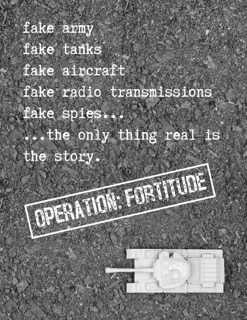
In 2022, UK-based producers contracted with legendary filmmaker Martin Scorsese to executive produce their World War II project, Operation: Fortitude. The UK producers would be telling a big, true story, about an outsize plan of deception pivotal to the Normandy invasion. And to jumpstart their project, they paid Scorsese half a million dollars upfront, with another half a million to follow.
Within weeks, though, the UK producers were complaining that Scorsese wouldn’t return their phone calls. A year later, they sued.1 Earlier this year, the parties entered into a confidential settlement.
Multiple Choice Question
Per the UK producers’ complaint, for the half million dollars, how much did Scorsese actually do?
A. ———Everything
B. ———Not everything, but a lot.
C. ———Not a lot, but something.
D. ———Not something, but not nothing.
E. ———Nothing.
For the correct answer and more, keep reading.
In January 2022, the UK producers and Scorsese entered into what looks like the proverbial, back-of-a-napkin agreement. Yes, it was typed and signed, but at a single page, it left out more than it included.
Back-Of-The-Napkin Terms
This pattern appears throughout the back-of-the-napkin agreement: deal points are introduced, but details are left for later.
Per the agreement:
++ Scorsese’s services were to be in connection with development, production and post-production, but his “exact services shall be mutually agreed on[.]”
++ $500,000 was paid on signature, while “[t]he payment schedule of the remaining [$500,000] shall be negotiated in good faith[.]”
++ Scorsese’s “additional compensation (box office bonus, streaming bonus, back-end etc.) shall be negotiated in good faith[.]”
++ “[C]onsultation/approval rights, including [Scorsese’s] mutual approval right over the director, script and all key creative elements, [Scorsese’s] first opportunity for subsequent productions etc. [. . .] shall be negotiated in good faith[.]”
Significantly, there was no timetable for performance of Scorsese’s services. He might perform now. Or, maybe, in the next decade.
Is This Any Way To Run An Airline?
In an iconic, mid-century advertising poster for National Airlines, a bathing-suited woman asks: “Is this any way to run an airline? You bet it is.2” The once high-flying National, though, is long gone.
While National may have figured out how to run an airline (use bathing-suited women, of course!), the Operation: Fortitude producers didn’t figure out how to buy their way into Hollywood. When you hire a filmmaker as busy, celebrated, and vintage as Scorsese (at the start of the Operation: Fortitude engagement, he was approaching 80), you want to address, in writing, the nature of the project, the reason for bringing on an EP like Scorsese, the specifics of what the EP is to do, the EP’s timetable and time commitment, and final decision-making authority. Plus, the four “D” scenarios: death, disability, default, and disagreement – the latter, for practical purposes, being perhaps the most important. None of these matters was adequately addressed in this back-of-the-napkin agreement.
What This Means For You
If you are a filmmaker or investor looking to bring on a name brand EP, but if, at the outset, you think it’s OK to postpone basic discussions with that EP, think again. Think of Operation: Fortitude.
And if you are an EP / consultant, if it’s not worth your time to figure out the contours of the assignment, is it worth taking on the assignment at all? Will you face reputational risk? Or litigation?
Returning to the Multiple Choice Test
Back to the test. Per the UK producers’ complaint, for the half million dollars, how much did Scorsese actually do?
A. ———Everything
B. ———Not everything, but a lot.
C. ———Not a lot, but something.
D. ———Not something, but not nothing.
E. ———Nothing.
The correct answer is E – Nothing.
Of course, these are allegations in a complaint. Since the case was settled, key facts, though pled, were not established in court.
Coda
Of course, words don’t just matter in a contract. They also matter in litigation – the complaint, answer, cross-complaint, etc.
In this case, the UK producers’ complaint was lean and business-like. Not so, Scorsese’s cross-complaint in which he sought to collect the remaining half-million of the million dollar fee. In that cross-complaint, Scorsese’s lawyers wrote, in pertinent part:
1. ———“This case presents the classic example of the novice filmmaker who refuses to appreciate the stark difference between expectation and reality[.]”
2. ———“[T]he entirety of [one of the UK producers’] film industry experience includes self-identifying as a screenwriter and producer[.]”
3. ———In approaching Scorsese, the UK producers “were desperately searching for a way to inject significant interest into their project.”
4. ———The UK producers’ “naïve hope was that by retaining Scorsese [Operation: Fortitude] would instantly be developed[.] [But] the agreement [. . .] contained no provisions whatsoever addressing the expected timeline[.]”
In other words, per Scorsese’s counsel, their celebrated client took a sizeable payday from confused, naïve, desperate nobodies who should have known better.
Yikes! An executive producer is a species of consultant. It is a consultant’s job to diagnose, provide expertise, and solve problems, all the while being a best-in-class communicator. Judges know this, and they don’t award points for insult comedy.
And is this the brand message Team Scorsese really wants to send to future investors? To anyone?
Film lovers: Next time you hear the words, “We’ve got Scorsese!”, let’s hope it doesn’t mean “Lawsuit to follow.”
- Op-Fortitude Ltd. v. Martin Scorsese and Sikelia Productions, Inc., 23STCV10888, CA Superior Ct (Central District, LA County), filed May 15, 2023 ↩︎
- www.pinterest.com/pin/national-airlines–335166397281522523/
↩︎
Ezra Doner is an entertainment and copyright lawyer who focuses on the film, TV and other content sectors. He is based in New York and is admitted to practice in New York and California. He does not represent any of the parties in this matter.
 Law Office of Ezra Doner